Building a shared AI standard for your entire team
Santiago Porta
8 min
The way teams work with AI is changing fast — and individual habits aren't enough. In this piece, Darwoft co-founder Santiago Porta makes the case for building shared AI standards that give every developer on your team the same foundation to work from. Because real digital transformation doesn't happen one person at a time.
The industry is changing. So must we.
We are past the AI hype cycle. What started as a set of exciting experiments has quietly become part of how software gets built. AI tools aren't optional upgrades anymore — they're becoming the default way developers work every day.
For the next generation of engineers, this shift is both an opportunity and a challenge. The developers who will thrive aren't just the ones who can write good code. They're the ones who know how to work alongside AI effectively, how to get consistent results, and how to contribute to something bigger than their individual output.
At Darwoft, we take this responsibility seriously. Part of our commitment to our crew is making sure nobody is left behind when it comes to the latest tools, trends, and working patterns in AI-assisted development. That means building shared knowledge — not isolated pockets of know-how.
AI tools aren't optional upgrades anymore — they're becoming the default way developers work every day.
Prompts don't scale. Standards do.
As AI becomes part of daily workflows, teams face a real coordination problem. Everyone develops their own habits, their own workarounds, their own way of getting results. Some people figure out great patterns. Most don't. And none of it gets shared.
The result is inconsistency. The same task yields different outputs depending on who handles it. Knowledge that should belong to the team stays stuck with one person. And when that person moves on, it disappears with them.
The AI is powerful. But without a shared standard, the way teams use it stays fragile.
One standard. One team.
At Darwoft, we're setting a shared AI standard. One way of working, available to everyone on the team, from day one.
Not a collection of individual prompts. Not tribal knowledge passed around informally. A real, structured standard — reviewed, maintained, and continuously improved by the team, for the team.
The goal is simple: the newest member of our crew should be able to work with the same confidence and consistency as the most experienced one. Because when everyone operates from the same foundation, the whole team moves faster, builds better, and grows together.
This Is bigger than tools
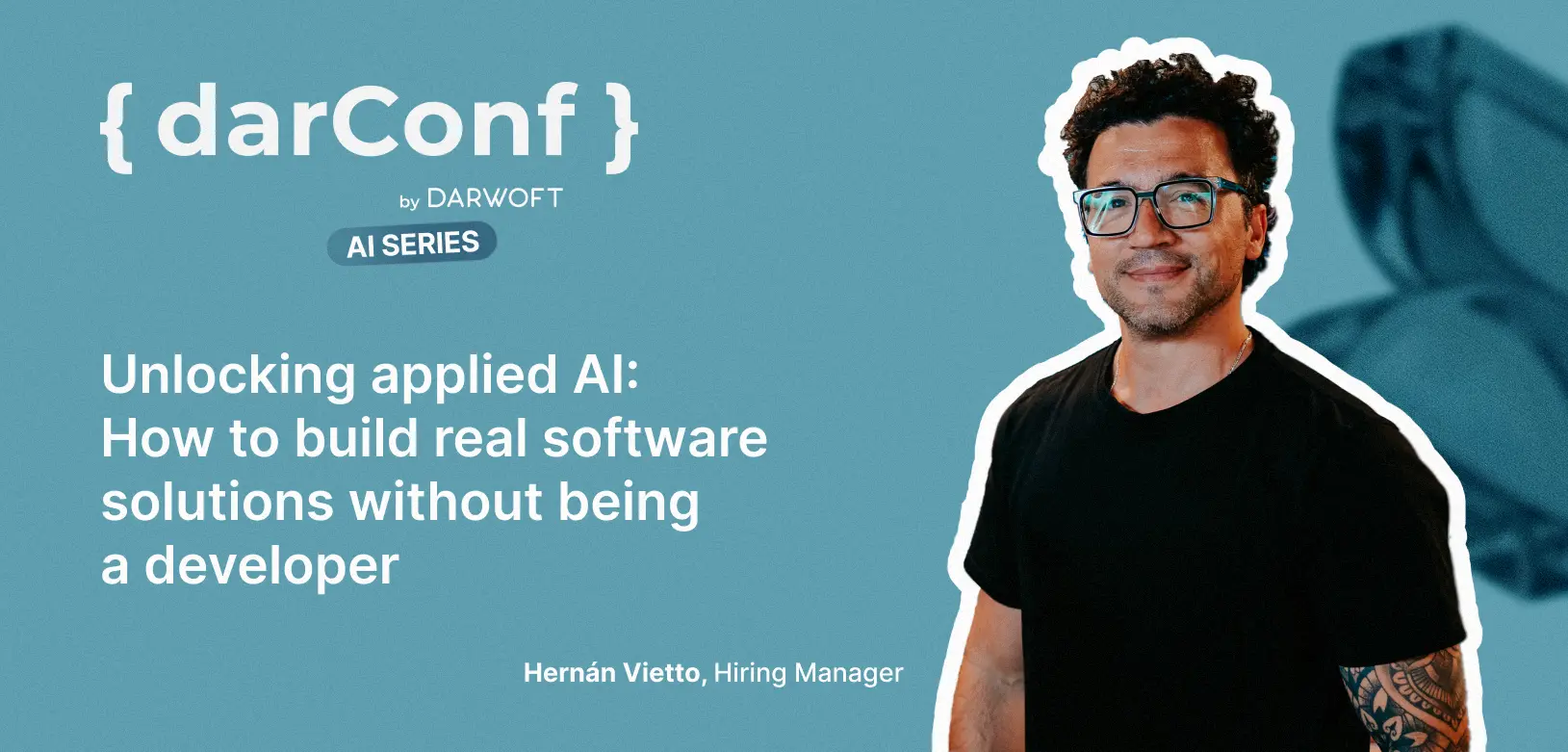
The conversation our co-founder Santiago Porta started at DarConf isn't really about technology. It's about what it means to go through a digital transformation as a team — not as a group of individuals each figuring it out alone.
AI is not replacing the engineers on our team. It's amplifying what they know. But for that amplification to work at scale, it needs to be built on shared rules, shared ideas, and a shared commitment to working as one.
That's the standard we're building at Darwoft. And we think every team serious about AI will need to build one too.
The future of development is shared
The developers who will define the next decade aren't just the ones who learned to use AI. They're the ones who helped their entire team do it, together.
That's what we're working toward.
I want to hear your thought about this. Let's talk.
Related Blogs
If you found this Blog insightful, you might also be interested in these related articles exploring similar topics in tech, design, and digital strategy.