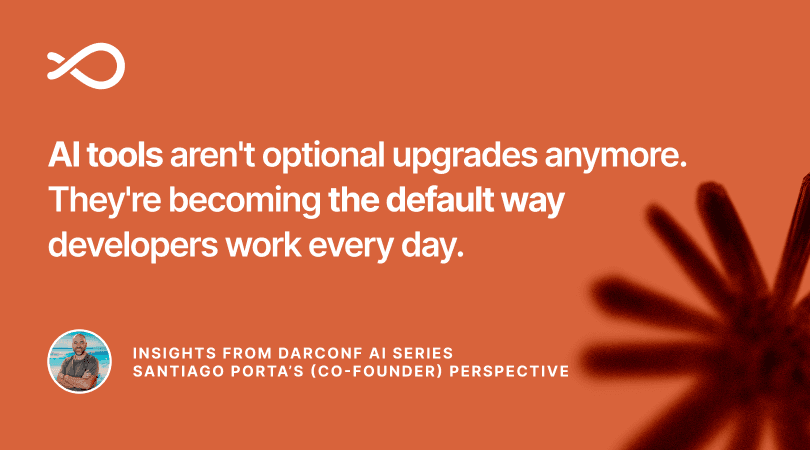
AI Adoption in practice: How to keep your team at the forefront of what's next

Waldemar Krumrick
3 minutes

AI is reshaping how developers think, build, and decide — and staying ahead means more than just knowing the tools. Here are 4 lessons from the field on adopting AI with purpose, judgment, and the right team behind you.
The tech industry is changing faster than most can keep up with. Artificial intelligence is no longer a distant promise or an experimental feature, it's part of the daily workflow of every developer, architect, and product thinker who wants to stay relevant. The new generation of developers entering the field isn't just learning languages and frameworks; they're learning to orchestrate, design, and make decisions that amplify human judgment through intelligent systems.
At Darwoft, we believe this evolution isn't something to fear, it's something to lead. That's why we invest intentionally in keeping our crew updated with the latest AI trends, tools, and practices. Our internal knowledge-sharing sessions are one of the ways we do this together. Because the best way to adopt AI isn't alone, it's collaboratively.
The Developer's role has shifted
Not long ago, the primary measure of a great developer was implementation speed: how fast you could ship a feature, how clean your code was, how well you knew your stack.
Today, that's only part of the picture.
The role has evolved toward orchestration. Developers are now expected to think about the bigger picture (system design, scalability, security, cost) and to make smart decisions about when and how AI fits in. That judgment doesn't come automatically. It has to be developed, practiced, and shared.
This is a nuance that gets lost in the noise of the AI hype cycle. With every new model release and every new framework, there's a temptation to apply AI to everything. But knowing when not to use it is just as valuable as knowing when to reach for it. The engineers who understand that distinction are the ones building things that last.
A few things we've learned along the way
Small automations create big, lasting impact
Some of the most valuable uses of AI aren't grand architectures, they're small, repeatable improvements that remove friction for the entire team. A quick automation that takes minutes to set up can save hours of rework over months. And because it benefits everyone, the return compounds quietly over time.
The lesson? AI adoption doesn't have to be complex to be meaningful. Sometimes the most impactful move is the simplest one.
Not every problem needs an AI solution
There's a well-known cognitive bias: once you have a hammer, everything looks like a nail. AI is a powerful tool, but it isn't always the right one.
Before reaching for an AI-powered solution, it's worth asking: is there a simpler, faster, more reliable way to get the same result? Sometimes the answer is yes. And recognizing that, choosing restraint over novelty, is itself a sign of technical maturity.
True progress isn't measured by what tech is shipped, but by what tech stays running: efficiently, purposefully, and at scale.
Challenge your ideas before you commit to them
We all walk into a new idea convinced it's solid. That's human nature. But the best engineers find ways to pressure-test their thinking before committing to a direction.
AI gives us a new way to do that, using different agent personas to get early feedback from multiple perspectives, surfacing blind spots before they become expensive mistakes. The result is better proposals, tighter reasoning, and fewer surprises down the road.
Systems improve with data, not just good intentions
Building something is only the beginning. The teams that continuously improve their AI-powered systems are the ones that invest in observability, logging outputs, tracking behavior, and using that data to ask better questions.
Without visibility into what's actually happening, optimization is guesswork. With it, small changes can unlock meaningful gains in performance, reliability, and cost.
Building the future, together
The shift happening in our industry isn't a disruption to survive, it's an invitation to grow. And at Darwoft, we take that seriously.
We keep our team sharp not just through individual learning, but through shared practice. Every example discussed, every question asked, every insight surfaced in those conversations becomes part of how we move forward, together.
The developers who will thrive in this new landscape aren't necessarily the ones who know the most tools. They're the ones who know how to think, about trade-offs, about purpose, about when to lean on AI and when to trust their own judgment. And they're the ones who stay curious, stay humble, and keep building alongside people who challenge and elevate them.
Because the future isn't only digital. It's emotional. It's collaborative. And it belongs to the teams who dare to shape what's next.
————-
This article is based on a talk delivered by Waldemar Krumrick as part of Darwoft's internal knowledge-sharing series, DarConf.
Related Blogs
If you found this Blog insightful, you might also be interested in these related articles exploring similar topics in tech, design, and digital strategy.