Tech Trends 2026: from AI hype to the age of agents and physical bots

Darwoft
3 minutes
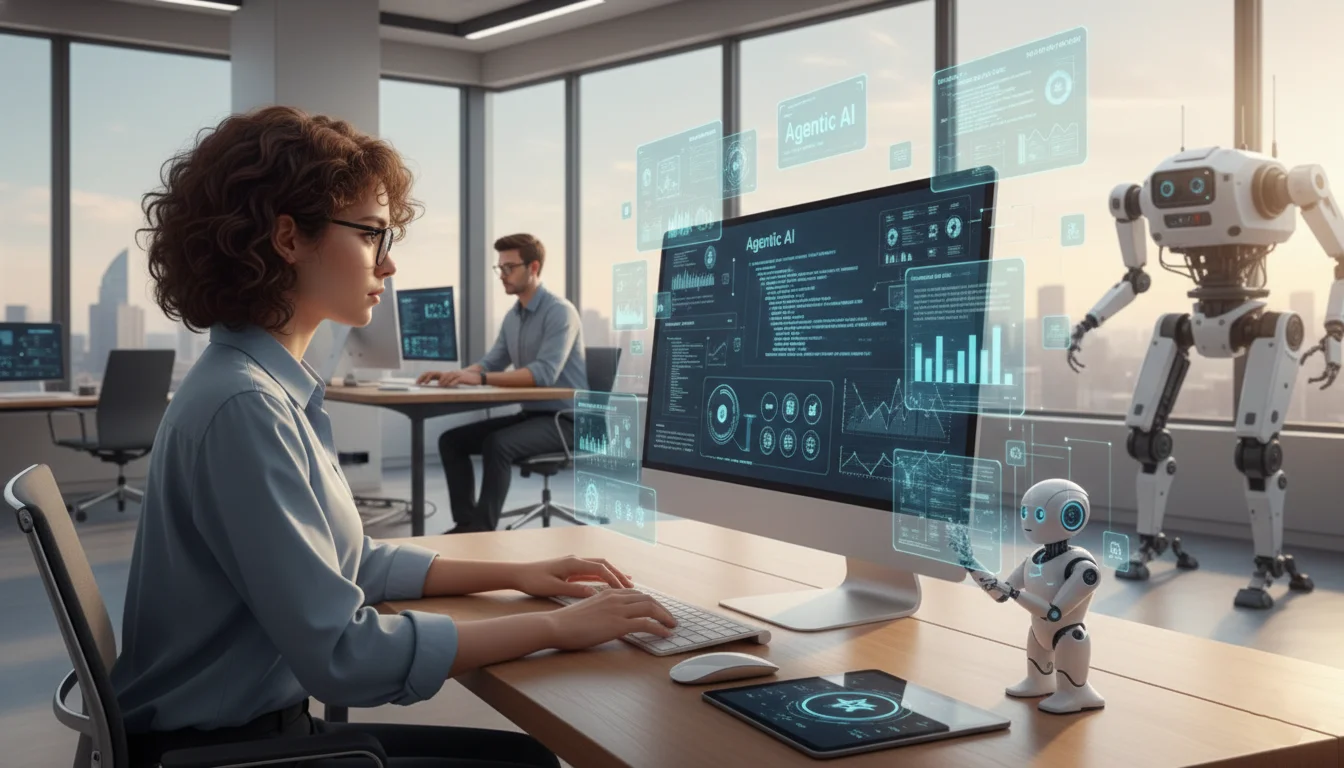
If 2024 and 2025 were the years of generative AI experimentation, 2026 marks the dawn of the Impact Era. The question is no longer "What can this technology do?" but rather "How is it fundamentally transforming my business and my life?"
If 2024 and 2025 were the years of generative AI experimentation, 2026 marks the dawn of the Impact Era. The question is no longer "What can this technology do?" but rather "How is it fundamentally transforming my business and my life?"
According to major forecasts from Gartner, Deloitte, Amazon, Microsoft, and WGSN, the technology landscape is shifting from passive chatbots to autonomous action. Here are the top 5 tech trends that will define 2026.
1. The rise of Agentic AI (beyond chatbots)
The most significant shift in 2026 is the move from Generative AI to Agentic AI. Unlike the passive tools of the past that simply answered questions, these autonomous agents can reason, plan, and—crucially—execute actions.
• The digital coworker: Microsoft predicts that agents will evolve into "digital coworkers," capable of handling complex workflows like real-time logistics or transaction management without constant human intervention. (Expand on this topic with our article of AI Digital Collaborators in 2026: Scaling measurable business impact)
• Business impact: Gartner forecasts that by 2026, 40% of enterprise applications will integrate embedded AI agents, up from less than 5% in 2025.
• ROI focus: Companies are moving past the "euphoria" phase. The focus is now on agents that drive measurable ROI, converting interactions into sales and loyalty.
For 2026 and beyond, disruption is accelerating and AI is no longer optional.
2. Physical AI: Robots as companions and workers
Artificial intelligence is breaking out of the screen and entering the physical world. This convergence of AI and robotics, known as Physical AI, is creating machines that can perceive, learn, and adapt to unstructured environments.
• The loneliness solution: Amazon CTO Werner Vogels predicts a revolution in companion robots. Powered by AI, these machines are becoming essential for elder care and combating the global loneliness epidemic, shifting from transactional devices to entities capable of building genuine emotional bonds.
• Workforce automation: From humanoid robots in warehouses to autonomous drones, machines are learning to navigate the real world with unprecedented autonomy. By 2035, millions of humanoid robots are expected to be active in the workforce.
3. The "renaissance developer" & human-centric skills
Far from the narrative that AI will replace developers, 2026 will see the rise of the Renaissance Developer. Just as polymaths of the past combined art and science, modern engineers will use AI to offload routine coding, allowing them to focus on creativity, system architecture, and complex problem-solving.
• Education revolution: In education, personalized learning will become the norm. AI tutors will adapt to every student's curiosity and learning style, democratizing access to quality education globally.
• Human-AI collaboration: The competitive advantage of the future lies in "human-machine teams." Success will depend on orchestrating this collaboration, ensuring trust, and maintaining human oversight in critical decisions. (Expand on this topic with our article of Digital collaborators: The new paradigm of AI Chatbots in digital transformation)
AI is no longer an experiment on the side: it’s rewiring how work gets done
4. Quantum-safe security: the new standard
With AI accelerating cyber threats, digital resilience is becoming a boardroom priority.
• The quantum threat: While fully fault-tolerant quantum computers are still maturing, the threat is immediate. Malicious actors are harvesting encrypted data now to decrypt it later. Companies like Amazon warn that "Quantum-safe" encryption is no longer optional; it is becoming the only safe standard to protect sensitive data against future quantum decryption.
• Preventive defense: Security is shifting from reactive to preemptive. Organizations are using AI to predict and neutralize threats before they materialize, a necessity in an era of automated cyberattacks.
5. Hybrid infrastructure & the inference economy
The massive energy consumption of AI is forcing a reckoning in IT infrastructure. The "cloud-only" strategy is proving too costly and slow for the inference economy (the cost of running AI models continuously).
• Edge Computing: To reduce latency and costs, processing is moving to the Edge—directly onto devices and local servers. This hybrid approach (Cloud + Edge) is critical for real-time applications like autonomous vehicles and smart factories.
• Sustainability: Sustainable tech is a top priority. We will see accelerated investment in data centers powered by renewable energy and even nuclear power to balance the voracious energy appetite of AI.
The takeaway for 2026? The future belongs to organizations that can bridge the gap between digital intelligence and physical reality. Whether it's deploying autonomous agents, securing data with post-quantum cryptography, or designing for human joy, 2026 is the year technology gets real.
Are you ready to lead the alliance?
Related Blogs
If you found this Blog insightful, you might also be interested in these related articles exploring similar topics in tech, design, and digital strategy.